


Movement
Maintaining physical balance during movement is critical for effectiveness. Losing balance while stepping into a strike compromises your ability to generate maximum power, speed, quickness, and accuracy.
It’s not about how many techniques you know; it’s about your ability to execute them with precision, power, and endurance when it matters most. To ensure success—especially in a real-life confrontation—always prioritize balance and control when performing self-defense techniques.
1. Stance: Your Foundation in a Confrontation
When facing a confrontational situation, your stance sets the foundation for effective action. Follow these key guidelines for optimal positioning:
-
Adopt a neutral, non-threatening posture. This helps de-escalate the situation while preparing you to act if needed.
-
Position your body for adaptability. Be ready for any necessary action, whether it’s to defend yourself or retreat safely.
-
Keep your knees slightly bent. Avoid locking your joints to maintain balance and agility.
-
Continuously assess the situation. Awareness is critical—each passing moment could require a shift in tactics or actions.
Remember, assessment is an ongoing process. Staying alert and adaptable can make all the difference in how you respond.

Neutral Stance

Neutral Stance

Defensive Stance
2. Stages of Conflict: Body Positioning Guidelines
Conflict situations typically unfold in three stages:
-
Resolution Negotiation
-
Resolution Action
-
Resolution Retreat
Your body positioning should adapt to each stage to maximize safety and preparedness.
Resolution Negotiation
At this initial stage, your goal is to de-escalate and resolve the conflict peacefully. Position yourself as follows:
-
Place one foot slightly forward, with normal side-to-side spacing.
-
Keep your torso square to the other person.
-
Raise your hands to create a protective barrier.
-
Maintain a safe distance if possible.
-
Distribute your weight evenly on the balls of your feet (not the heels).
-
Align your toes and knees to ensure stability.
Note: Maintaining a safe distance isn’t always possible. Stay alert and adjust your position as needed throughout this stage.
Resolution Action & Resolution Retreat
If the conflict escalates to physical self-defense, shift from a neutral stance to one that prioritizes protection and readiness for action. In this stance:
-
Prioritize movement efficiency for striking, blocking, or evading.
-
Adjust your position to optimize defense and power.
If the conflict resolves peacefully, increase your distance from the individual(s) while staying mentally, emotionally, and physically aware. Monitor your surroundings to ensure no further threats arise during your exit.
Note: Comfort should guide which foot you position forward. Your stance should allow for quick, powerful, and accurate transitions.
3. Balance & Defense
Balance is crucial for executing effective self-defense techniques, especially when dealing with a larger assailant. Proper balance enhances power, speed, and accuracy, even under physical duress.
-
Train both sides of your body equally to ensure agility and strength in all directions.
-
Develop the ability to move left, right, forward, or backward seamlessly.
4. Evasion Movements
Evasion movements help you avoid grabs or strikes by minimizing your attacker’s success. Adhering to these rules improves your chances of escaping safely:
Evasion Movement Rules:
-
Be aware of your environment.
-
Maintain feet apart; avoid crossing your legs.
-
To decrease distance, step forward with your front foot first.
-
To increase distance, step with either foot.
-
Move your upper and lower body in sync.
-
Always regain and maintain balance.
Evasion Movement Patterns:
Evasion may involve lateral movements, pivots, or stepping to angles to avoid direct engagement. Practice these movements to build confidence and precision in high-stress scenarios.

Front Leg (1)

Front Leg (2)

Rear Leg (1)
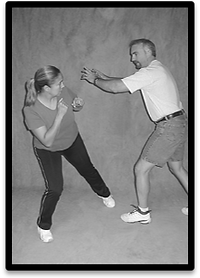
Rear Leg (2)